Field Guide Match: shiny distractions and impulse trades
The Dopamine Goblin
Shiny distractions & impulse trades
Dopamine Goblin shows up when the stimulating thing keeps winning even though you still care about the boring thing.
Start here
Practical help before the lore
Dopamine Goblin shows up when the stimulating thing keeps winning even though you still care about the boring thing.
You might be here if...
- You start the task and drift to tabs, pings, or side quests within minutes.
- A reward helps, but only if you decide it before the distraction hits.
- The problem is not knowing what matters; it is keeping the shiny thing from hijacking the session.
Best first ritual
Make a short work contract, pre-select the reward, and let the goblin earn its shiny.
Fastest tool
A visible one-task contract that pairs well with reward binding and distraction blocking.
- Triggers: Shiny tabs, phone pings, novelty cravings when tasks feel dull.
- First counter-move: Make a 20-minute Goblin deal with a pre-picked reward.
- Printable: Single-Task Oath card
🏰 I. Bestiary Entry
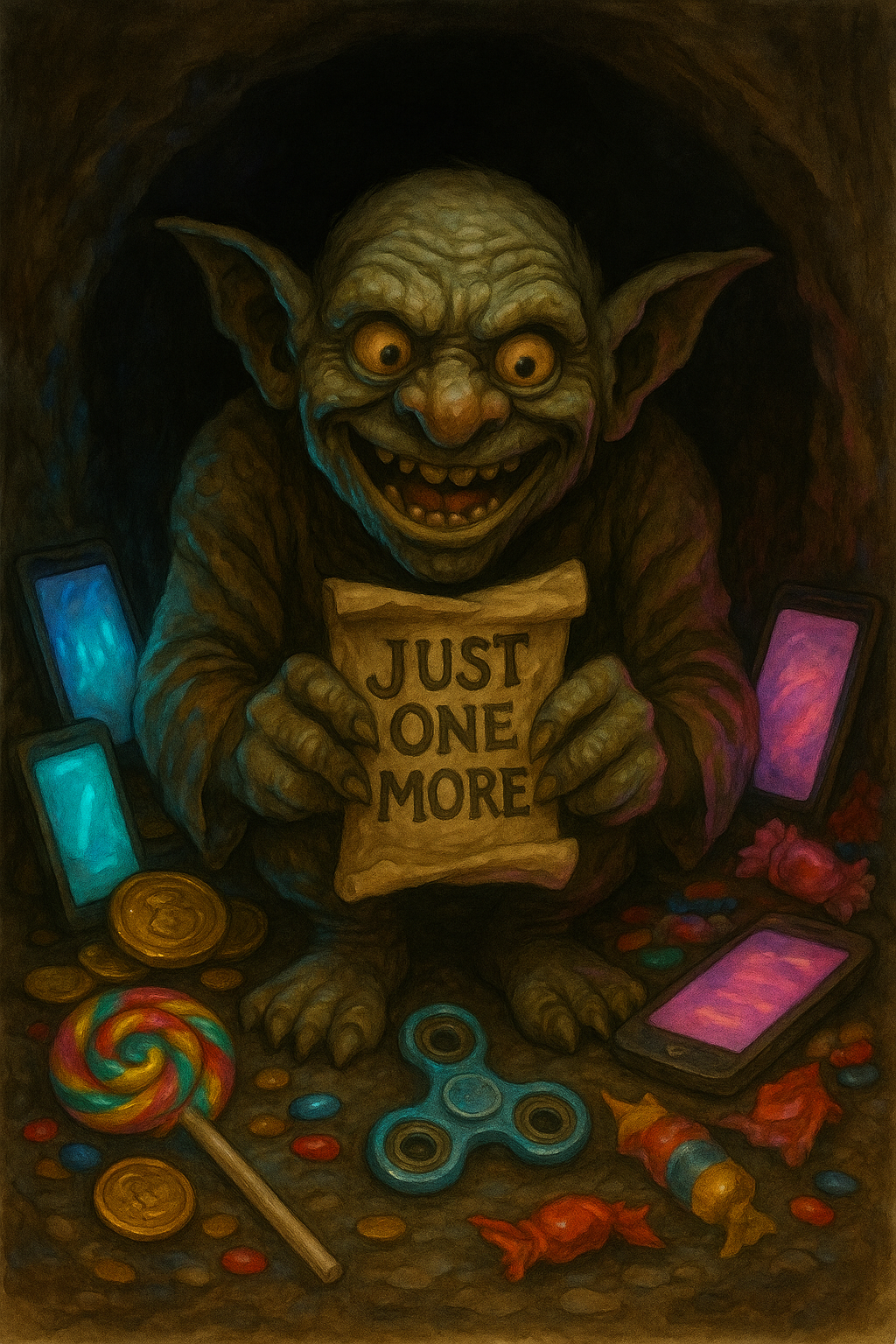
The Dopamine Goblin is small but mighty. It scuttles around the edges of your mind, waving shiny objects and shrieking “THIS is better!” It is a trickster spirit. It thrives on novelty, instant rewards, urgent distractions. It cannot kill you directly—but it can steal your hours one bite at a time. It promises fun. It delivers delay. It feeds on your need for stimulation.
In myth, goblins are thieves, mischief-makers, lords of chaos. Your Dopamine Goblin is the spirit of just one more scroll, just one more game, just one more idea.
You cannot kill the Goblin. But you can bargain with it. You can trap it. You can bribe it to work for you.
🔎 Monster Ecology (Lore and Sources)
- Goblins in folklore → clever, greedy, can’t resist shiny things.
- ADHD brains = novelty-seeking, reward-driven, boredom-averse. (Barkley, 2015)
- Dopamine deficit → strong bias for immediate over delayed rewards. (Volkow et al., 2009)
- Delay discounting → prefer smaller-sooner over larger-later. (Sonuga-Barke, 2003)
- Digital distractions = infinite supply of shiny bait.
🧠 III. Clinical / Psychological Explanation
- ADHD is not a knowledge deficit—it’s a performance consistency problem.
- Dopamine‐regulated reward systems favor novelty and immediacy.
- Screens, social media, games → hyperstimulating, easy hits.
- Hard, boring tasks = low dopamine payoff → micro-avoidance.
- Solution = intentional salience, delayed gratification training, environmental design.
🔍 IV. Real-World Examples
- Reaching for the phone mid-task.
- Starting work, then opening social media.
- Checking email obsessively.
- Watching “just one more” video.
- Having 20 open tabs of new ideas.
- Switching hobbies instead of finishing.
🗝️ The Dopamine Goblin’s Weaknesses
- Pre-negotiated rewards.
- Clear time boundaries.
- High-salience framing for boring tasks.
- Environmental friction (blocking distractions).
- Novelty channeled into useful places.
- Humor → trick the Goblin to help.
🪄 Rituals and Counter-Spells
⭐ Invocation: “Goblin, make a deal.”
- Negotiate: “If I do X for 20 min, I get Y.”
⭐ Goblin Jar
- Write impulses on paper, seal them for later.
- Ritual of containment.
⭐ Boundaries of the Realm
- Use blockers or timers.
- Physical distance → no phone on desk.
⭐ Reward Binding
- Explicit promise: “After I do X, I get Y.”
- Forces the Goblin to earn its keep.
⭐ Novelty Ritual
- Rotate music, workspace, tools intentionally.
- Controlled novelty to satisfy its itch.
🛠️ Artifacts and Weapons
- Goblin Jar → Physical place for postponed ideas.
- Contract Scroll → Written deal with yourself.
- Time Stone → Timer or Pomodoro app.
- Shield of Friction → App blockers, filters.
- Bait of Choice → Pre-selected reward.
- Mirror of Intent → Written session goal.
⚡️ VIII. Command Phrases
“Goblin, make a deal.” “Earn your shiny.” “Not now, little monster.” “Later is not never.” “Contain the chaos.” “I choose the reward.”
🧪 IX. Science and Reason
- Delay discounting is steeper for ADHD brains. (Sonuga-Barke, 2003)
- “If-Then” plans increase follow-through. (Gollwitzer, 1999)
- Environmental friction reduces impulsivity.
- Behavioral Activation → intentional reward binding.
- Self-monitoring curbs mindless switching.
🛡️ X. Challenge for the Reader
- Name YOUR Dopamine Goblin.
- Define its favorite lie.
- Write your personal deal phrase.
- Build your Goblin Jar.
- Plan your reward binding.
- Test it for 7 days.
- Share your contract with the Guild.
“The Goblin is clever. Be cleverer.”