
Field Guide Match: overwhelm from too many tasks
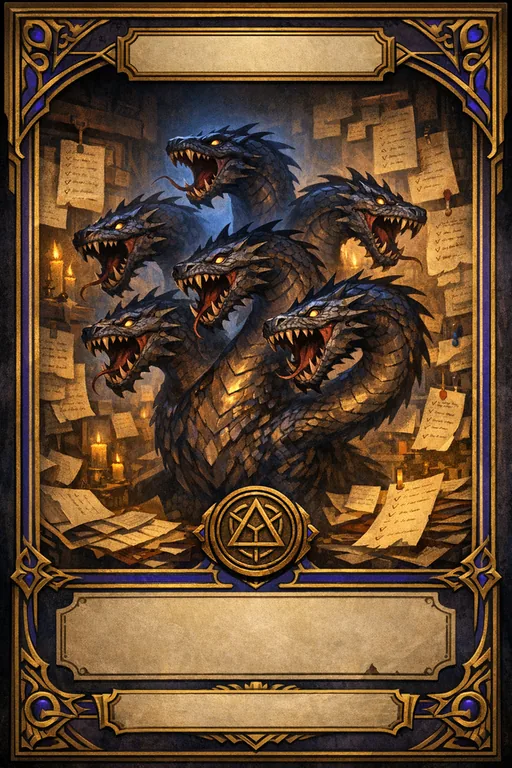
The Task Hydra
Too many heads, not enough focus
Task Hydra shows up when too many open loops are screaming at once and choosing the first task feels harder than doing it.
Start here
Practical help before the lore
Task Hydra shows up when too many open loops are screaming at once and choosing the first task feels harder than doing it.
You might be here if...
- You keep reorganizing the list instead of starting.
- Every task feels urgent, so your brain treats them all like a threat cloud.
- You switch to new tasks before the first one has a chance to shrink.
Best first ritual
Pick one task, hide the rest, and say no to new heads until you finish the first cut.
Fastest tool
A quick focus card for naming the one head you are striking right now.
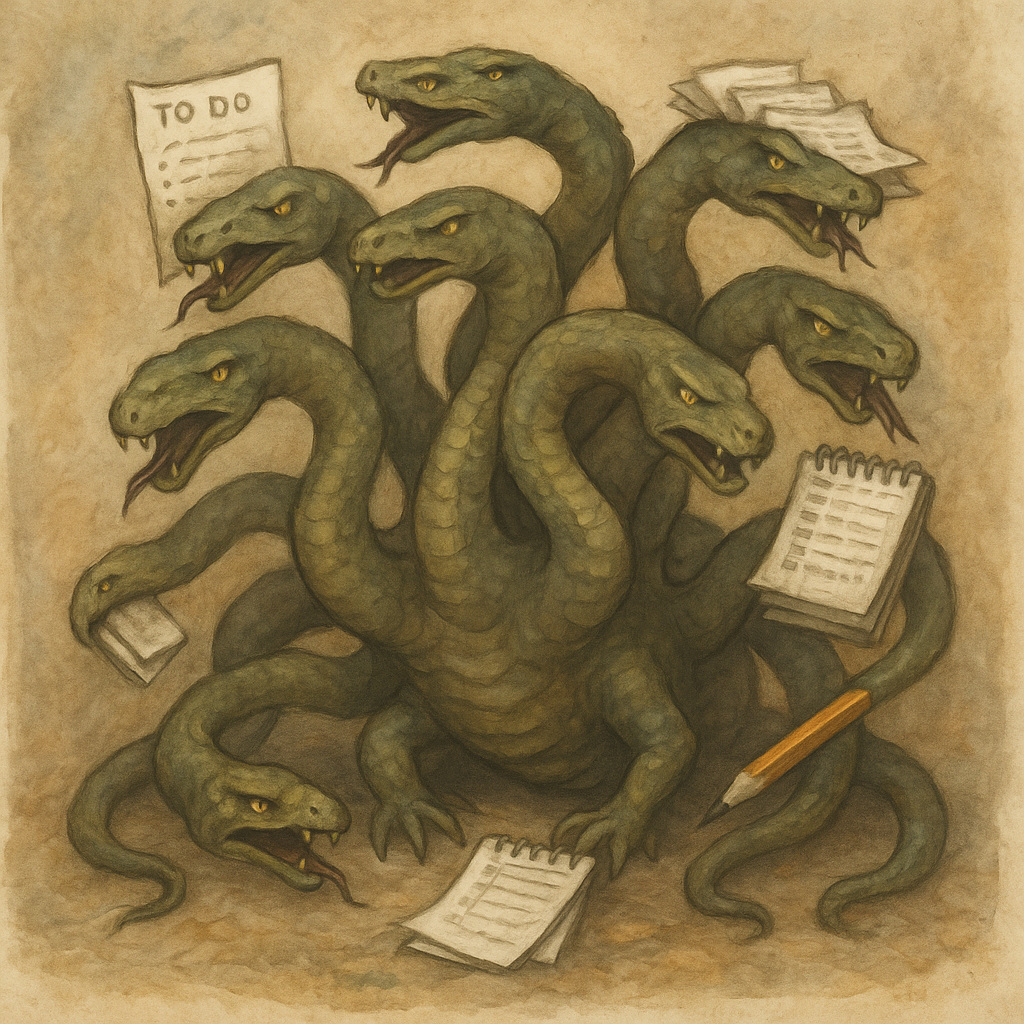
- Triggers: Endless to-do lists, new heads sprouting mid-task, panic from scattered priorities.
- First counter-move: Choose one head, light the focus torch, and swear the Single-Task Oath.
- Printable: Single-Task Oath card
Lore
The Task Hydra is the many-headed beast of overwhelm. For every task you complete, two more seem to sprout. It lives in endless lists, scattered priorities, open tabs, overflowing inboxes, and the kitchen junk drawer of your mind.
It does not roar. It hisses. “You’ll never finish.” “You don’t even know where to start.” “Why bother at all?”
In ancient myth, the Hydra was nearly invincible because cut heads regrew. Heroes needed strategy, fire, and persistence. The Task Hydra works the same way. You cannot kill it all at once — you choose which head to strike, cauterize the stump, and call on allies to hold the torch while you swing.
Monster Ecology
- The Lernaean Hydra of Greek myth could not be slain by brute force — heads regrew unless burned shut.
- Overwhelm tends to multiply tasks rather than reveal priorities; the open loops keep talking until something forces closure.
- ADHD brains often struggle most at the prioritization layer, not the execution layer.
- Unclosed tasks stay loud in working memory even when you are not actively thinking about them.
- Context-switching has a real cost; “I’ll come back to this” is rarely free.
Real-World Examples
- Staring at a giant to-do list and doing nothing.
- Starting five chores at once and finishing none.
- Making a new list instead of acting on the current one.
- Endless “planning” that never converts to execution.
- Feeling defeated before you have even begun.
- Procrastinating because you cannot pick where to start.
The Task Hydra’s Weaknesses
- Prioritization rituals reduce decision fatigue at the start of a session.
- Chunking turns one large task into a sequence of smaller, defined steps.
- Single-tasking refuses to grow new heads mid-swing.
- Externalized lists — whiteboards, sticky notes, kanban boards — get the Hydra out of your head and onto a surface you can see.
- Time blocking pre-commits your focus before the new tabs and pings arrive.
- Closure rituals “burn the stump” so the same head does not quietly regrow.
- An accountability spell — telling another person what you will do — turns the social contract into something real.
Rituals and Counter-Spells
Choose the Head
- “Which task is THE priority?” Name it out loud or in writing.
- One head only. The others can sprout while you swing.
Torch Ritual
- Light a candle or lamp as a physical cue that focus time has started.
- “This is my hunting torch.”
Single-Task Oath
- “I do not grow new heads.”
- Put other tools away. No switching mid-battle.
3-Item Rule
- Limit today’s list to three critical tasks.
- The fourth one is a Hydra head trying to grow back.
Find the practical write-up on the Rituals page.
Tools and Printables
- Torch of Focus — candle or lamp marking work time.
- Blade of Choice — a physical object (pen, knife) pointed at today’s single task.
- Scroll of Tasks — an externalized list outside your head.
- Seal of Completion — strike-through, checkmark, or physical closure ritual.
- Shield of Limits — a timer or alarm for work sessions.
-
Bag of Holding — an inbox or bucket to catch new tasks without acting on them yet.
- Single-Task Oath card
- Ink-friendly PDF
- If your overwhelm is mixed with deadline panic, pair this with Temporal Shark.
- If the heads are sprouting because of constant pings rather than real tasks, see Sensory Storm.
Command Phrases
- “Choose the head.”
- “No new heads today.”
- “Cauterize the stump.”
- “One quest at a time.”
- “List outside, brain clear.”
Science and Reason
- Open, unfinished tasks occupy working memory and create background cognitive load that does not go away on its own.
- Externalizing the list reduces that load — the page holds the task so your brain does not have to.
- Chunking and clear prioritization reduce decision fatigue at the start of a session.
- Single-tasking is consistently more efficient than rapid switching; the switch cost is real even when each switch feels small.
- Ritual cues drive action when motivation alone is not enough.
(For deeper context, see Zeigarnik 1927 on unfinished tasks, Monsell 2003 on switch costs, and Barkley 2015 on executive function in ADHD.)
Challenge for the Reader
- Name your Task Hydra out loud. What is it actually demanding right now?
- Define its favorite lie. (“Everything is equally urgent” is a common one.)
- Choose your one head for today and ignore the rest until it is struck.
- Light your torch — pick the physical cue you will use to mark focus time.
- Notice whether the sky fell. It usually does not.
“The Hydra cannot be slain in one swing. But one head at a time? That’s how heroes win.”